Fascinating of butterfly

Butterflies have magnificent colors and fly cheerfully from flower to flower in the air. Since their behavior do not bite or sting, butterfly is a insect model of innocence.
Tampilkan postingan dengan label Inachis Io. Tampilkan semua postingan

Jumat, 01 Juli 2011

The Butterflies–III of Liechtenstein

image

The “Butterflies – III” issue, again designed by Stefan Erne, depicts two more harbingers of spring, the Orange Tip and the Peacock.
The stamps have been issued by Liechtenstein Post on June 6, 2011.


image

The “Peacock”, Inachis io (face value CHF 2.20) from the Nymphalidae family was the “Butterfly of the Year 2009”. The Peacock can be found in woods, fields, meadows, pastures, parks, and gardens, and from lowlands up to 2,500 metres elevation. It is a relatively common butterfly seen in many European parks and gardens. 
Because of global warming this butterfly now regularly forms a second generation in the late summer, it has been chosen to draw attention to the consequences of climate change. The Peacock butterfly is resident in much of its range, often wintering in buildings or trees. It therefore often appears quite early in spring.
The conspicuous black, blue and yellow eyespots on its russet-coloured wings serve as effective protection for the Peacock against its natural enemies. When danger threatens, in a flash the butterfly spreads its wings to display their striking upper side, leading the predator to imagine itself confronted by a large creature proportional to the eye(spot)s.
 
image
The Orange Tip  or  Anthocharis cardamines (face value CHF 5.00), whose German name the “Aurora” Butterfly was inspired by the goddess of the dawn, can be observed in spring in large swarms in Liechtenstein’s valley landscape.
Both males and females of this species of White have white wings, the outer half of the forewings being coloured orange only on the males. The males are a common sight in spring flying along hedgerows and damp meadows in search of the more reclusive female which lacks the orange.The irregular yellowish/dirty green and white speckled pattern on the underside of the hind wings is however common to both sexes.
 

Minggu, 05 Juni 2011

Butterflies of Faroe Islands 2010

PPA020210_Large


Butterflies and Moths
To date, 154 different species of butterflies have been registered in the Faroe Islands. Most of them do not breed here, but arrive with the help of warm currents of air from the south, sometimes all the way from Southern Europe and Africa. New species are constantly being registered. It can be mentioned as an example that only 54 species had been registered in 1954 and that this had increased to 106 by 1999. Compared with the countries that lie to the south of the Faroes, 154 species is no great number.
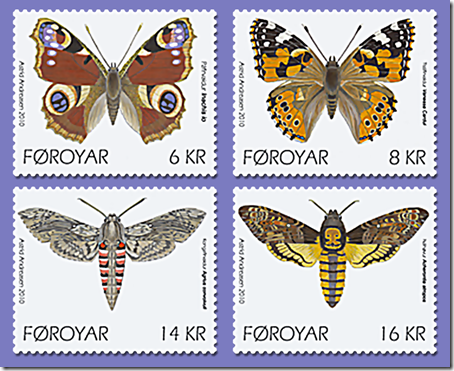
None of the species mentioned here are native to the Faroes, but can be seen here from time to time. On 22 February 2010, Faroes Island Post issued the stamp series depicted butterflies and moths.The painted lady, Vanessa cardui, and the peacock butterfly belong to the brush-footed family, Nymphalidae, and fly during the day. The hawk-moth, Agrius convolvuli, and the death’s-head hawk-moth, Acherontia atropos, belong to the Sphingidae family of moths and fly from twilight until late at night.

The peacock butterfly, Inachis io , 6kr stamp.
The peacock butterfly is a rare guest in the Faeroes and was first registered here in 1938. The species is native to the countries south of us, such as Great Britain, Denmark and Norway. It has a wingspan of between 5-6 cm and an eye-spot at the tip of all four wings that resemble the ‘eyes’ on a peacock’s tail. The caterpillar, which lives on stinging nettles, (Urtica dioica) has been found in the Faroes only once and that was at Haldórsvík in 1992. In the countries the peacock butterfly is native to, it usually hibernates in such locations as warehouse buildings so it sometimes arrives in the country together with freight.

The painted lady, Vanessa cardui , 8kr stamp.
The painted lady has a wingspan of 5-6 cm and is resident in North Africa. It is not seen in the Faroes every year, but some years see an invasion of them, such as in 2009, which has been called a record year throughout Europe. When they come to the Faroes they fly immediately to the top of the mountains. This phenomenon is known as “hill topping” and gives them a fine opportunity to find a mate once they have arrived in the new country. They then lay their eggs on the creeping thistle (Cirsium arvense) and on stinging nettles (Urtica dioica) that the caterpillars feed on. A new generation hatches in the autumn if the summer has been fine and the butterflies fly south to winter in warmer countries.
The first time we hear about the painted lady in the Faroes is from expeditions during the period 1863-68. The butterfly can travel long distances and one found its way to the far north in Svalbard in 1978.


The hawk-moth, Agrius convolvuli (Linnaeus, 1758)
The hawk-moth, which was first registered in the Faroes in 1947, comes from North Africa. Eleven of them were observed in the Faroes in 2003 and, as they are very rare here, this constituted a record year. They can have a wingspan of 12 cm and can fly as fast as 55 kilometres an hour. The hawk-moth lives on nectar and, like the hummingbird, it can hover in mid-air on its rapidly-beating wings while it feeds on nectar with the help of its long proboscis. The caterpillar lives on various species of the Convolvulaceae family, in the Faroes on plants of the dock family, Rumex.


The death’s-head hawk-moth, Acherontia atropos (Linnaeus, 1758)
This very rare guest from North Africa is the biggest moth ever found in the Faroes and can have a wingspan of more than 13 cm. The death’s head hawk moth is one of the few moths that can whistle by blowing air through its proboscis. The female moth lays between 150 and 200 eggs, but the population has declined greatly. This is due to the fact that the caterpillar lives in areas where potatoes are grown and the commercialisation of potato-growing has led to the use of large quantities of pesticides. New, modern agricultural machinery is also believed to have had a negative effect on the population.

Rabu, 01 September 2010

Butterflies of Jersey 1991


In 1991, Jersey post issued 4 stamps that depicted species Melitaea cinxia on 15 p, Euplagia quadripunctaria on 20 p, Deilephilia porcellus on 37p and Inachis io on 57p.

Minggu, 29 Agustus 2010

Butterfly on Ireland stamps 2000

In 2000, Ireland Post has issued the beautiful mini sheet stamps depicted the four butterflies in the flower plant. The species are Inachis Io, Aglais urticae, Argynnis paphia, Anthocharis cardamines.

Inachis Io or the Peacock can be found in woods, fields, meadows, pastures, parks, and gardens, and from lowlands up to 2,500 metres (8,200 ft) elevation. It is a relatively common butterfly seen in many European parks and gardens.

Aglais urticae is a well-known colourful butterfly, found in temperate Europe. This is a species often found in gardens. The common named is The Small Tortoiseshell.

Argynnis paphia or Silver-washed Fritillary is a European species of butterfly, which was in decline for much of the 1970s and 1980s, but seems to be coming back to many of its old territories. Its has deep orange with black spots on the upper side of its wings, and has a wingspan of 54–70 mm, with the male being smaller and paler than the female. The underside is green, and, unlike other fritillaries, has silver streaks instead of silver spots, hence the name silver-washed.

Anthocharis cardamines is a butterfly in the Pieridae family and have orange tip to his forewings. Therefore so called the Orange tip butterfly. It can be found across Europe.

Butterfly stamps of Isle of Man

The stamp series depicted 5 species of butterfly, Argynnis aglaja, Cynthia cardui, Celastrina argiolus, Vanessa atalanta, and Inachis io. These stamps have issued by the Postal Administration of Isle of Man on 1993.

Argynnis aglaja is not exactly rare in the UK it is quite widespread throughout the UK occurring in a variety of habitats, e.g. moorland, downland, woodland, coast etc.Very fast flying.The common named is Dark Green Fritillary.

Cynthia Cardui is species of the Nymphalidae family, found from North Africa to Nothern Europe. The common named is Painted Lady.

Celastrina Argiolus is a butterfly that belongs to the Lycaenids family and is native to Eurasia and North America.The common named is Holly Blue.

Vanessa Atalanta is is a well-known colourful butterfly, found in temperate Europe, Asia and North America. The species is resident only in warmer areas, but migrates north in spring, and sometimes again in autumn.The common named is Red Admiral , has a two-inch (45–50 mm) wing span.

Inachis Io is a colourful butterfly, found in Europe, temperate Asia as far east as Japan.The common named is the European Peacock butterfly and resident in much of its range, often wintering in buildings or trees.
Related Posts Plugin for WordPress, Blogger...